
The cycle finished and the machine went quiet, but the bottom of your GE dishwasher is still full of standing water. Whether your GE dishwasher is not draining at all, leaves water sitting in the basin after every cycle, or stopped draining mid-wash, this guide covers every cause we see across Halifax. GE dishwashers come in two filter designs depending on the model year, and the drain pump uses a locking tab system that is worth understanding before you start. This guide covers both.
- Clogged filter and sump area (most common, free to fix)
- Blocked or kinked drain hose
- Garbage disposal knockout plug not removed (common after new installations)
- Failed drain pump
- Control board fault
GE dishwashers come in two filter configurations depending on model year. Newer GE and GE Profile models use a tool-free twist-out filter. Older models require a screwdriver to access the filter assembly. Both are covered in Cause 1 below with separate instructions and videos.
Mapleland Appliance is a locally owned appliance repair company in Halifax, NS. We write these guides from real repair experience to help you diagnose the problem yourself, and we are available for same-day service across HRM when you need a hand.
✓ I want to try fixing it myself
Read on. This guide walks you through all 5 causes in order of likelihood, with step-by-step instructions and the tools you need.
📞 I’d rather have a technician handle it
No problem. We service GE dishwashers across Halifax and HRM. Same-day appointments available. $89.9 flat diagnostic fee.
Safety notice: These guides are for informational purposes only. Appliance repair involves electrical and water hazards. Always disconnect power and shut off the water supply before starting any work. If you are unsure about any step, stop and call a technician. Mapleland Appliance is not liable for injury or damage resulting from DIY repair attempts.
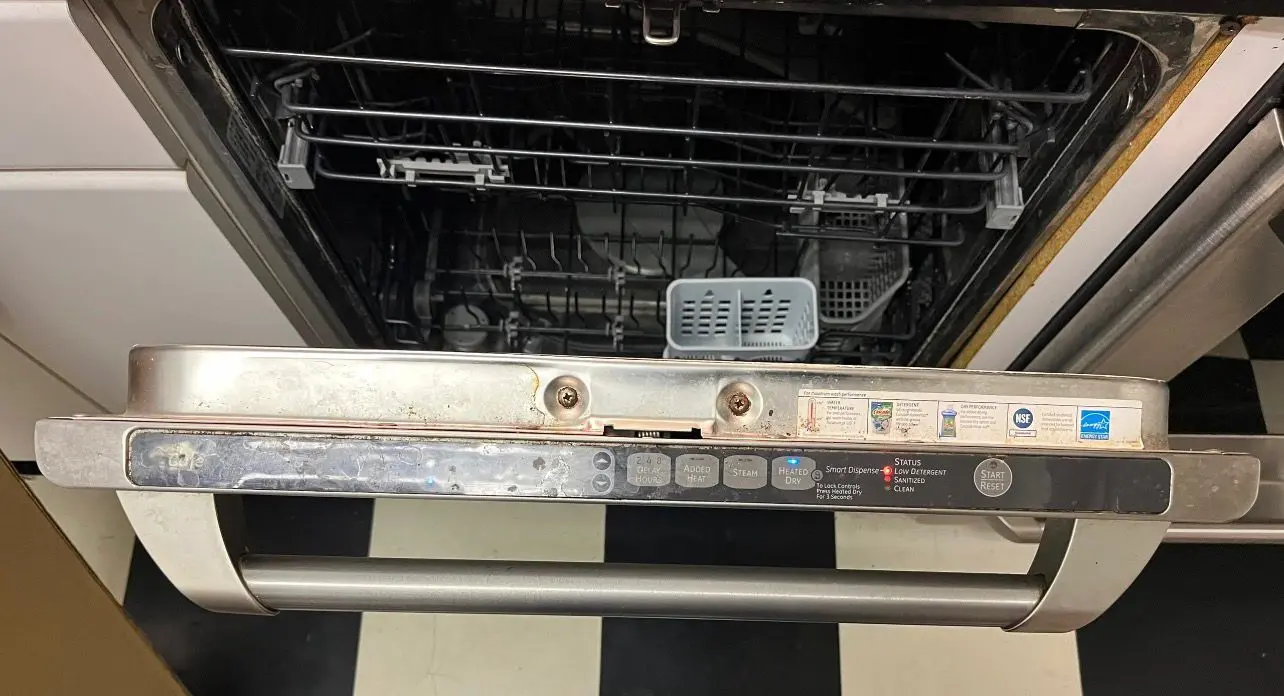
5 Most Common Causes of a GE Dishwasher Not Draining
| Component | DIY Difficulty | Est. Cost (CAD) |
|---|---|---|
| Clogged Filter and Sump Area | ⭐ Easy | $0, DIY clean |
| Blocked or Kinked Drain Hose | ⭐ Easy | $0–$15 replacement hose |
| Garbage Disposal Knockout Plug | ⭐ Easy | $0, DIY remove |
| Failed Drain Pump | ⭐⭐⭐ Hard | Part $50–$120, total $140–$220 with labour |
| Control Board Fault | ⭐⭐⭐ Hard | From $200 total with labour |
* Prices shown are estimates only. Actual costs may vary depending on your model and parts availability. Call us for a quote before you decide.
Clogged Filter and Sump Area
What it is: GE dishwashers collect food debris, grease, and mineral deposits in a filter assembly at the base of the tub. When this filter clogs, water cannot pass through to the drain pump and pools in the basin after every cycle. This is the first thing to check on any GE dishwasher that is not draining, because it is free to fix and takes about ten minutes.
According to GE Appliances’ official cleaning guide, regular filter maintenance is essential for effective drainage and optimal wash performance. In Halifax, we recommend cleaning the filter every three weeks rather than the standard monthly interval. Nova Scotia’s water supply carries higher mineral content than most inland Canadian cities, and that calcium combines with food residue and detergent to form a paste that blocks the filter mesh faster than the manufacturer’s cleaning schedule assumes.
GE makes two different filter designs depending on model year. Check which type you have before starting:
Newer GE and GE Profile models (tool-free): The filter system sits at the centre bottom of the tub. The ultra-fine filter is a round cylindrical piece that twists counter-clockwise and lifts straight out. Beneath it, the fine filter mesh plate lifts up and out from under two rear retaining tabs. No screwdriver needed.
Older GE models (screwdriver required): The filter cover is secured by screws and requires a Phillips screwdriver or drill to remove before the filter assembly can be accessed. If you see screws in the filter area, you have an older model.
Symptoms:
- Standing water in the bottom of the tub after every cycle
- Dishes coming out with a gritty film or food particles still attached
- Musty smell from inside the dishwasher between uses
- Draining has become progressively slower over several weeks
- Unplug the dishwasher and remove the bottom rack.
- Grip the ultra-fine filter (the round cylindrical piece at the centre of the tub floor) and rotate it counter-clockwise until it releases. Lift it straight out.
- Lift the fine filter mesh plate up and forward, sliding it out from under the two rear retaining tabs.
- Rinse both filter pieces under warm running water. Use a soft brush or toothbrush to scrub the mesh. For calcium buildup, soak in undiluted white vinegar for 15 minutes before scrubbing.
- Look into the sump cavity and remove any visible debris with a damp cloth.
- Reinstall the fine filter mesh plate under the rear retaining tabs, then reinsert and twist the ultra-fine filter clockwise to lock. Reinstall the rack, plug in, and run a rinse cycle to confirm drainage.
This video demonstrates the filter cleaning process on newer tool-free GE and GE Profile models:
- Unplug the dishwasher and remove the bottom rack.
- Locate the filter cover at the bottom of the tub. Remove the screws with a Phillips screwdriver or drill.
- Lift the filter assembly out of the sump cavity.
- Rinse under warm running water and scrub with a soft brush. Soak in white vinegar for 15 minutes if calcium buildup is present.
- Clean the sump cavity, replace the filter, reinsert and tighten the screws, and run a test cycle.
This video covers filter access and cleaning on older GE dishwasher models:
Blocked or Kinked Drain Hose
What it is: The drain hose carries water from the pump to a standpipe or garbage disposal under the sink. A sharp kink anywhere along the hose or a grease buildup inside it stops water flow entirely. The pump runs but nothing drains. This problem most often appears after the dishwasher has been moved, or when new cabinetry has been installed around it.
Under the Nova Scotia Building Code, dishwasher drain connections must maintain specific clearance and depth requirements to prevent backflow. In older Halifax and Dartmouth apartments, standpipes are often narrower than current code requires. If the drain hose is inserted more than 7 inches (18 cm) into the standpipe, it creates a siphon effect that either prevents draining or pulls dirty water back into the tub between cycles. This is one of the most common drain problems we diagnose in Halifax apartments and costs nothing to fix.
Symptoms:
- Pump runs audibly but water level does not drop
- Problem appeared after the dishwasher was moved or kitchen work was done
- Dirty water reappears in the tub between cycles even after the machine drains
- Shut off power at the breaker and the water supply valve under the sink.
- Open the cabinet under the sink and trace the drain hose from the dishwasher to its connection point.
- Check the full length of the hose for sharp bends or kinks, particularly where it passes through cabinet walls.
- Confirm the hose has a high loop, rising up to the underside of the counter before descending to the drain connection. A hose running straight down without looping will siphon water back into the tub.
- If connecting to a standpipe, confirm the hose is not inserted more than 7 inches into the pipe.
- Disconnect the hose and pour water into the open end. Free flow means the hose is clear. A slow or blocked flow means an internal clog that needs to be cleared or the hose replaced.
- Reconnect, restore power and water, and run a test cycle.
Garbage Disposal Knockout Plug Not Removed
What it is: If your GE dishwasher was recently installed and has never drained properly from the first use, check for a garbage disposal knockout plug before assuming any component has failed. When a dishwasher drain hose connects to a garbage disposal, there is a factory-installed plastic plug inside the disposal’s dishwasher inlet port that must be knocked out before the hose is connected. If an installer skips this step, water from the dishwasher has nowhere to go.
This is a universal installation issue across all dishwasher brands. The full step-by-step removal process is identical regardless of brand and is covered in detail in our Frigidaire dishwasher not draining guide and our Whirlpool dishwasher not draining guide.
Symptoms:
- Dishwasher has never drained since it was installed
- A garbage disposal was installed at the same time as the dishwasher
- Wash cycle runs normally but drain cycle produces no water movement at all
Failed Drain Pump
What it is: The drain pump uses an electric motor to push water out of the sump and through the drain hose. When it fails, water stays in the basin regardless of how many cycles you run. A jammed impeller produces a grinding or humming sound during the drain phase. A burned-out motor is completely silent when the drain cycle should be running.
On GE built-in dishwashers, the drain pump is accessed from the underside of the machine after it has been pulled out from under the counter. The machine must be tilted backward so a technician can reach the pump from beneath. Before moving the machine, the 120V hardwired power connection at the wall junction box must be disconnected and the water inlet line shut off and physically separated.
GE’s pump locking tab system: GE drain pumps are held in place by a plastic retaining tab that clicks into the sump housing when the pump is rotated into position. To remove the pump, you must first use a flat-head screwdriver to gently press the retaining tab inward, then rotate the pump body approximately one quarter turn to release it. The tab must be fully released before rotating. Forcing the pump body without fully releasing the tab will snap the tab, which can crack the sump housing and turn a straightforward pump replacement into a significantly more expensive repair.
An additional caution specific to Halifax: Hard water mineral deposits from Nova Scotia’s water supply can cause the pump seal to bond partially to the sump housing over years of continuous use. If the pump does not rotate freely after the tab is released, do not force it. Apply gentle pressure only and give the seal time to release.
Symptoms:
- Grinding or humming during the drain cycle with no water movement (jammed impeller)
- Complete silence during the drain phase where pump noise is expected (burned-out motor)
- Filter is clean and hose is clear, but machine still will not drain
- Run a cycle and listen carefully during the drain phase. A steady hum means the pump is running. Grinding or rattling points to a jammed impeller. Complete silence during the drain phase points to a burned-out motor.
- Confirm the filter is completely clean first. A heavily clogged filter can cause the pump motor to overheat and trip its thermal protector, which mimics a failed motor. Clean the filter and run a cool rinse cycle before concluding the pump has failed.
- If the pump is confirmed failed: shut off power at the breaker, disconnect the water supply, remove the mounting brackets, carefully pull the machine out from under the counter, and tilt it backward to access the pump from the underside.
- Using a flat-head screwdriver, gently press the plastic retaining tab inward to release it. While holding the tab released, rotate the pump body approximately one quarter turn. The pump will pull straight out once fully released.
- Disconnect the wiring harness and test the motor with a multimeter on continuity mode. No continuity confirms motor failure.
This video covers the full GE dishwasher drain pump removal and replacement process including the locking tab release:
Control Board Fault
What it is: The control board sends the electrical signal that activates the drain pump at the correct point in each cycle. If the board fails to send that signal, the pump receives no power and the machine sits with a full basin of water after every cycle. The wash phase may run normally and no obvious mechanical fault is present. The machine simply does not drain.
This is the last cause to consider because it is the least common and the most expensive. If you have worked through Causes 1 through 4 and found nothing wrong with any component, a control board fault is the likely remaining explanation.
Symptoms:
- All components test as functional but the drain pump never activates
- Machine stalls at the same point in every cycle with no error code
- Multiple unrelated error codes appearing together
GE Dishwasher Error Codes and Drain Faults
GE dishwasher error codes vary significantly by model year and control board generation. Older GE models with mechanical controls display no error codes at all. Newer GE and GE Profile models with digital displays may show drain-related codes, but the exact code format depends on your specific model. If your GE dishwasher is displaying an error code you are not sure how to interpret, call us with the code and model number and we can advise over the phone before you book anything.
Should You Repair or Replace Your GE Dishwasher?
According to the Insurance Bureau of Canada, water damage from household appliances is one of the leading causes of home insurance claims across Atlantic Canada, with dishwashers among the most common sources. A GE dishwasher that is not draining puts ongoing stress on the pump, hoses, and door seals. Addressing the fault promptly prevents a small drain issue from becoming a water damage claim.
Rule 1: The 50% Rule. If the total repair cost (parts plus labour) exceeds 50% of the price of a comparable new GE dishwasher, replacement is usually the better long-term financial decision.
Rule 2: The Lifespan Rule. GE dishwashers typically last 9–12 years with regular maintenance. If your machine is under 6 years old, repair almost always makes sense. Over 9 years old with a major component failure, replacement deserves serious consideration.
Rule 3: The Recurring Failure Rule. If this is the second or third component failure within 18 months, the machine is in general decline. Isolated failures are normal. A pattern of failures is not.
At Mapleland Appliance, we assess the dishwasher, explain exactly what has failed, give you a clear repair quote, and tell you honestly whether fixing or replacing makes more financial sense. No pressure either way. Call us and we will tell you straight.
Frequently Asked Questions
How much does it cost to fix a GE dishwasher not draining in Halifax?
It depends on the cause. Cleaning a clogged filter costs nothing and takes about ten minutes once you know your filter type. A drain hose adjustment or replacement runs $0–$25 in parts. Removing a missed disposal knockout plug is free. A drain pump replacement starts from around $140–$220 total with labour. At Mapleland Appliance, our diagnostic fee is $89.9 and we give you a clear quote before any work begins.
How do I manually drain a GE dishwasher?
GE dishwashers do not have a dedicated emergency drain hose. To remove standing water manually, open the door and use a cup or ladle to bail water out into a bucket. A wet-vac inserted into the bottom of the tub is faster and more thorough. Once the tub is empty, clean the filter and sump area thoroughly. This cleaning step alone resolves the problem in many cases. Do not run another cycle until you have identified why the water did not drain the first time.
My GE dishwasher is new and has never drained properly. What should I check first?
If your GE dishwasher has never drained correctly since installation and it connects to a garbage disposal, check for the disposal knockout plug first. This is a plastic disc inside the disposal’s dishwasher inlet port that must be knocked out before the drain hose is connected. It is a required installation step that gets missed regularly when a disposal and dishwasher are installed in the same visit. Full instructions are in Cause 3 above. If the plug is absent or removing it does not fix the problem, confirm the drain hose has a proper high loop under the counter and is not inserted too deeply into the standpipe.
How often should I clean my GE dishwasher filter in Halifax?
Every three weeks, rather than the standard monthly recommendation. Halifax’s municipal water supply has higher mineral content than most inland Canadian cities, and that calcium combines with food residue and detergent to clog the filter mesh faster than the manufacturer’s maintenance schedule assumes. A filter clean takes about ten minutes on newer tool-free GE models and slightly longer on older screwdriver-access models. Regular cleaning also extends the life of the drain pump by reducing the debris load it has to handle on every cycle.
GE Dishwasher Repair in Halifax, NS
If your GE dishwasher is not draining and the repair is beyond a comfortable DIY fix, Mapleland Appliance is a locally owned appliance repair company serving Halifax and the surrounding HRM communities. We provide dishwasher repair in Halifax and across the region, with same-day and next-day appointments available.
We service GE and GE Profile dishwashers across Halifax, Dartmouth, Bedford, and surrounding areas. We carry common GE drain pump assemblies and complete most repairs in a single visit.
Mapleland Appliance
📞 (782) 409-2734
📍 Serving Halifax, Dartmouth, Bedford, Sackville, and Cole Harbour, NS
💰 $89.9 diagnostic fee, clear pricing with no hidden costs
🕐 Same-day and next-day appointments available
GE Dishwasher Not Draining?
We diagnose the problem clearly, give you an upfront quote, and fix it fast. Or tell you honestly if it is not worth repairing.
Same-day and next-day appointments across Halifax and HRM.