
You finish a wash cycle, open the lid, and find your clothes sitting in a tub full of dirty water. Whether your Whirlpool washer won’t drain at all, leaves standing water after the cycle, stopped mid-wash with water in the tub, or is showing an F21 error, the cause almost always comes down to one of five things. This is one of the most common Whirlpool washer complaints we see across Halifax and HRM, and this guide covers every cause we’ve encountered in the field.
- Clogged drain hose
- Blocked pump filter / coin trap
- Failed drain pump
- Lid switch or door lock fault
- Control board error or cycle glitch
This guide walks you through each cause, how to safely check it yourself, and when it’s time to call a technician.
Mapleland Appliance is a locally owned appliance repair company in Halifax, NS. We write these guides from real repair experience to help you diagnose the problem yourself, and we are available for same-day service across HRM when you need a hand.
✅ I want to try fixing it myself
Read on. This guide walks you through all 5 causes in order of likelihood, with step-by-step instructions and the tools you need.
📞 I’d rather have a technician handle it
No problem. We service Whirlpool washers across Halifax and HRM. Same-day appointments available. $89.9 flat diagnostic fee.
Safety notice: These guides are for informational purposes only. Appliance repair involves electrical and mechanical hazards. Always disconnect power and water before starting. If you’re unsure about any step, stop and call a technician. Mapleland Appliance is not liable for injury or damage resulting from DIY repair attempts.
Why Won’t My Whirlpool Washer Drain?
The first thing to understand is that washing and draining are two separate systems inside your washer. The wash motor can complete an entire cycle, agitating and rinsing, while the drain pump has failed entirely. That’s why clothes end up soaking in dirty water even after the display shows the cycle is done.
5 Most Common Causes of a Whirlpool Washer Not Draining
| Component | DIY Difficulty | Est. Cost (CAD) |
|---|---|---|
| Drain Hose | ⭐ Easy | $0 — DIY clean |
| Pump Filter / Coin Trap | ⭐ Easy | $0 — DIY clean (front-load only) |
| Drain Pump | ⭐⭐⭐⭐ Hard | Part $100+, total with labour $180+ |
| Lid Switch / Door Lock | ⭐⭐ Moderate | $20–$80 for part, get a quote for labour |
| Control Board | ⛔ Do not DIY | Technician assessment required |
* Prices shown are estimates only. Actual costs may vary depending on your washer’s model and parts availability. Call us for a quote before you decide.
Clogged Drain Hose (Most Common)
What it is: The drain hose is the flexible tube that carries water from your washer to your home’s drain pipe or standpipe. Over time, lint, soap scum, and small debris accumulate inside and restrict or completely block water flow.
Halifax local context: Halifax has moderately hard water. Mineral deposits combine with soap residue to accelerate buildup inside drain hoses faster than in soft-water areas. If you haven’t checked your drain hose in over a year, this is where to start.
Symptoms: Water drains very slowly or not at all after a cycle. You may notice a sour or stale odour from the hose area. The washer may stop mid-cycle with water still in the tub.
- Unplug the washer and turn off the water supply.
- Pull the washer away from the wall and locate the drain hose at the back.
- Check whether the hose is kinked, bent sharply, or crushed against the wall. Straightening a kink alone can be the entire fix.
- Check the height of the drain hose where it enters the standpipe. Whirlpool recommends the hose end sits between 18 and 96 inches from the floor. Too low causes siphoning; too high makes the pump work too hard.
- If no kink is visible, disconnect the hose at both ends and check inside for debris blockage. A flashlight and a straightened wire hanger can help clear visible blockages.
Blocked Pump Filter / Coin Trap
What it is: The pump filter sits just before the drain pump and catches small objects before they reach and damage the pump impeller. Think of it as a last-chance net for coins, hairpins, buttons, and lint. When it fills up, water has nowhere to go.
Top-load Whirlpool washers do not have a pump filter. If you have a top-loader, skip directly to Cause 3.
Many Whirlpool front-loaders do not have an access door on the front panel. You may need to remove the entire lower toe panel using a nut driver to reach the coin trap. Check your model’s manual for the exact location before assuming there is a convenient access door.
Symptoms: Slow draining or no draining at all. You may hear a humming or buzzing sound. The washer may display an F21 or F9 E1 error code.
- Unplug the washer.
- Locate the filter access, either a small door on the lower front panel, or remove the lower toe panel by prying gently with a flathead screwdriver or unscrewing with a nut driver.
- Place your tray and towels. Slowly turn the filter cap counterclockwise, a quarter turn at a time, to release water gradually.
- Once drained, fully remove the filter cap and pull out the filter.
- Remove any coins, hairpins, lint, or debris. Rinse the filter under running water. Check the filter housing for any remaining debris.
- Reinsert the filter, tighten clockwise until snug, replace the access panel, and run a short drain/spin cycle to test.
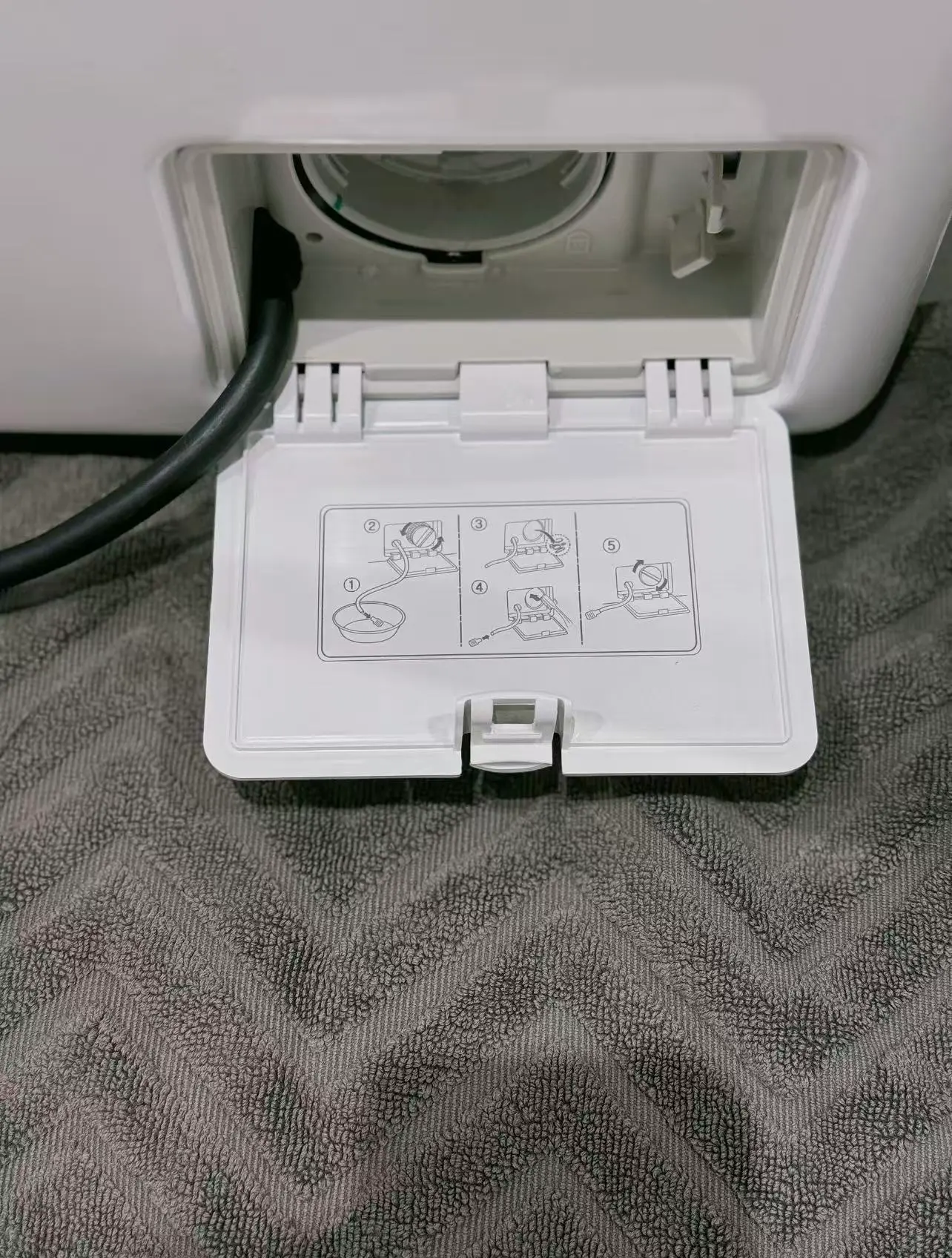
The pump filter (coin trap) access point on a Whirlpool front-load washer. Location varies by model.
Failed Drain Pump
What it is: The drain pump physically forces water out of the machine. Inside the pump is an impeller, a small spinning blade, that creates the pressure needed to push water through the drain hose. If the pump motor burns out, or if the impeller is jammed by a foreign object, the washer cannot drain.
Symptoms: No draining after clearing the hose and filter. You may hear humming with no water movement (impeller jammed), or complete silence when the drain cycle should start (motor burned out). The water level stays exactly where it was at the end of the wash cycle.
- Confirm you have already checked the drain hose (Cause 1) and the pump filter (Cause 2 if applicable). The pump is the next step only if those checks came back clear.
- If you can hear humming but no water movement, the impeller may be jammed. On some models you can access the pump from the front after removing the lower panel and manually check whether the impeller spins freely.
- To test the pump motor electrically, use a multimeter set to continuity mode. A working pump motor shows continuity. A burned-out motor shows OL.
Lid Switch or Door Lock Fault
What it is: The lid switch and door lock confirm the machine is safely closed before operating, but they behave very differently when they fail.
Traditional top-load Whirlpool (agitator models): If the lid switch fails, the washer will still drain water normally but will not spin. The drain system on classic top-loaders does not require the lid switch signal. Only the high-speed spin cycle requires that signal. So if your top-load Whirlpool drains fine but leaves clothes soaking wet, the lid switch is the first thing to test.
Newer HE top-load and front-load Whirlpool models: These use an electronic door lock mechanism. If this lock fails, the machine stops entirely, no draining and no spinning. The control board receives no door-closed confirmation and refuses to proceed with any part of the cycle.
Symptoms:
- Top-load (agitator): Washer drains but will not spin, clothes come out soaking wet
- HE top-load / front-load: Washer stops completely after wash cycle, no draining, no spinning, no response
- Unplug the washer.
- Top-load: Open the lid and locate the lid switch, a small plastic tab under the lid rim. Test with a multimeter on continuity mode. A working switch shows continuity when pressed and OL when released.
- Front-load / HE top-load: Visually inspect the door latch assembly for visible damage. Try closing the door firmly and listen for the click of the lock engaging. If the door doesn’t lock positively, the lock assembly needs replacement.
Control Board Error or Cycle Glitch
What it is: The control board sequences every part of the wash, rinse, and drain cycle. Occasionally a power fluctuation, static discharge, or software glitch causes the board to fail to trigger the drain cycle, even when every mechanical component is working perfectly.
Symptoms: Water left in the tub after a cycle but the washer otherwise seems normal. No unusual sounds, no obvious mechanical issue. The display may show an error code or show the cycle as completed with no indication of a problem.
- Unplug the washer completely from the wall outlet.
- Wait a full 5 minutes. This allows the control board’s capacitors to discharge and forces a full reset.
- Plug back in and select the Drain and Spin cycle only, not a full wash cycle. This isolates whether the drain system itself is working.
- If the washer drains successfully on this cycle, the earlier failure was likely a one-time glitch. Run a test load and monitor.
- If an error code appears, note it and check the table below.
Whirlpool Washer Error Codes Related to Draining
If your Whirlpool washer is displaying an error code, it is telling you directly where the problem is. Here are the codes specifically related to drainage failures:
| Error Code | What It Means | Recommended Action |
|---|---|---|
F21 / F/21 |
Drain cycle taking too long | Check drain hose for kinks first, then clean the pump filter. Most F21 errors clear after filter cleaning. |
F9 E1 |
Long drain time (HE models) | Same as F21 — start with hose and filter check. |
Sd / Sud |
Excessive suds detected | Run a Rinse and Spin cycle only. Use less detergent going forward. HE washers require HE-specific low-suds detergent only. |
F5 E2 |
Door lock fault | Inspect the door latch for damage. Try closing the door firmly. If the code persists, the door lock assembly needs replacement. |
F0 E2 |
Drain pump fault detected | Check the pump filter first. If clear, the pump motor may have failed and needs professional assessment. |
Quick tip: For any error code, unplug the washer for 5 minutes before restarting. Whirlpool’s control board can reset minor faults on its own. If the same code appears immediately after restart, the underlying component has genuinely failed.
Not sure what your error code means or what to do next? Call us and we will diagnose it on the spot.
Should You Repair or Replace Your Whirlpool Washer?
Once you have identified the problem, the next question is whether it is worth fixing. Here is the framework we use when advising customers:
Rule 1 — The 50% Rule: If the total repair cost (parts + labour) exceeds 50% of the price of a comparable new Whirlpool washer, replacement is usually the better long-term financial decision.
Rule 2 — The Lifespan Rule: Whirlpool washers typically last 10–14 years with regular maintenance. If your washer is under 7 years old, repair almost always makes sense. If it is over 10 years old and facing a major component failure, replacement is worth serious consideration.
Rule 3 — The Multiple Failures Rule: If this is the second or third component failure within 12 months, the machine is likely in general decline. At this point, replacement is usually more economical than continued repair.
If you are not sure which category your situation falls into, the most useful step is an honest diagnosis. At Mapleland Appliance, we assess the washer, explain exactly what has failed and what the repair will cost, and give you a straight answer on whether fixing or replacing makes more sense. No pressure to proceed either way. Call us and we will tell you straight.
Frequently Asked Questions
How much does it cost to fix a Whirlpool washer that won’t drain in Halifax?
It depends on the cause. Clearing a blocked drain hose or pump filter is a DIY fix with no parts cost. If the drain pump itself has failed, the part starts at around $100 CAD and total repair cost including labour is typically $180 or more. At Mapleland Appliance, our diagnostic fee is $89.9 and we give you a clear quote before any work begins.
Can I keep using my Whirlpool washer if it won’t drain?
You can run it, but your clothes will come out soaking wet and the standing water will develop mould and odour quickly. More importantly, if the root cause is a blocked drain hose or a failing pump, continuing to run the machine can put additional stress on the pump motor and turn a cheap fix into an expensive one. Diagnose it before running another cycle.
Whirlpool Washer Repair in Halifax, NS
If the repair is beyond a comfortable DIY fix, or you would simply rather have a professional handle it, Mapleland Appliance is a locally owned appliance repair company serving Halifax and the surrounding HRM communities.
Our technicians are equipped to service all Whirlpool washer models, including top-load agitator, top-load impeller, and front-load configurations. We carry common Whirlpool parts and complete most repairs in a single visit.
Mapleland Appliance
📞 (782) 409-2734
📍 Serving Halifax, Dartmouth, Bedford, Sackville, and Cole Harbour, NS
💰 $89.9 diagnostic fee, clear pricing with no hidden costs
🕐 Same-day and next-day appointments available
Whirlpool Washer Full of Water?
We diagnose the problem clearly, give you an upfront quote, and fix it fast. Or tell you honestly if it is not worth repairing.
Same-day and next-day appointments across Halifax and HRM.